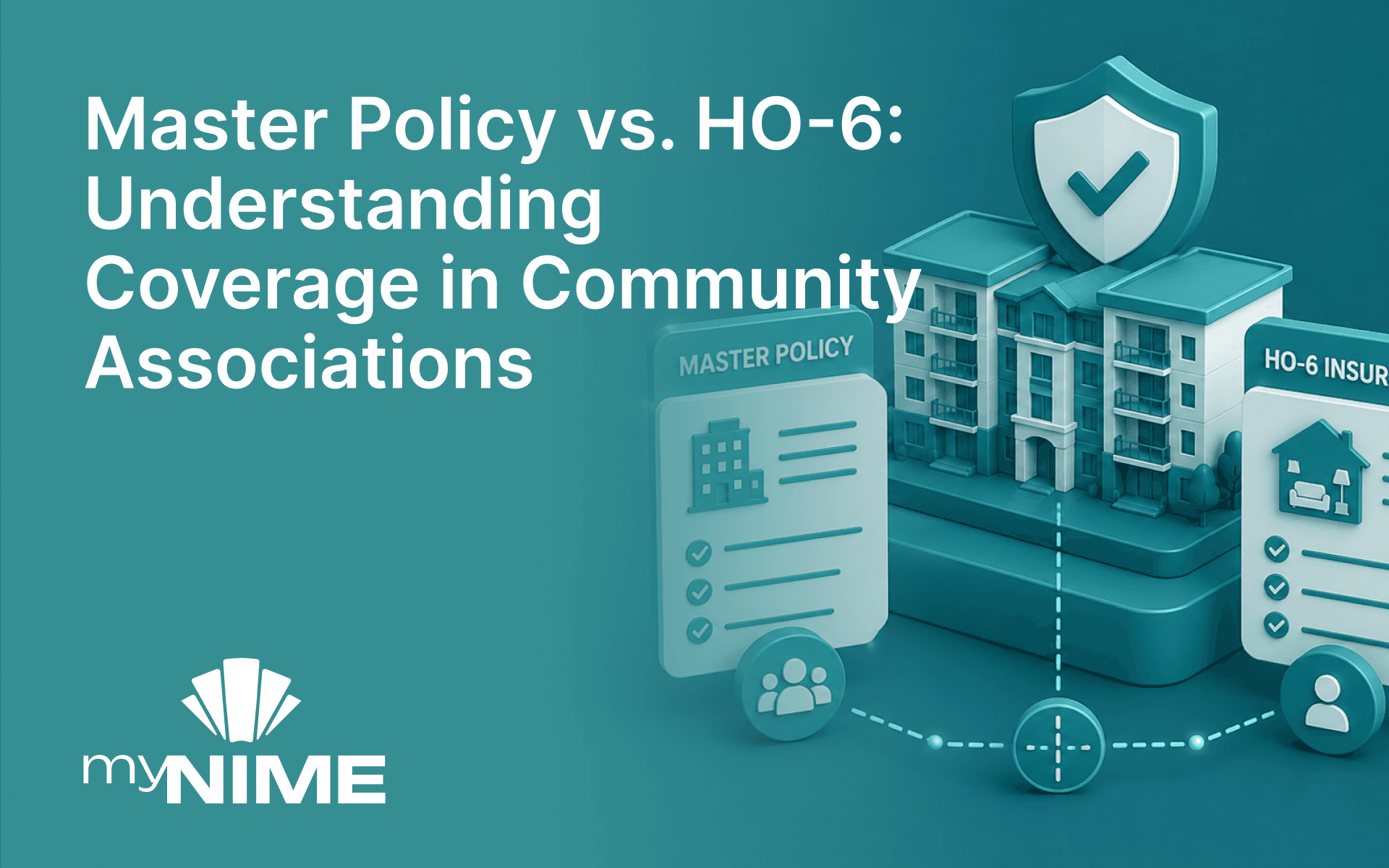


Master Policy vs. HO-6 Insurance: Understanding the Coverage Line Inside Community Associations
Insurance in community associations operates through layered protection. A building’s master insurance policy protects the structure and shared property, while individual unit policies protect the interior space and personal property within each residence. When boards, property managers, brokers, and residents understand how these layers interact, claims move more efficiently and financial responsibilities remain clear.
Confusion around these policies remains one of the most common sources of misunderstanding during insurance claims. Residents often assume the building’s insurance covers everything within their unit, while boards sometimes discover that gaps in unit coverage shift unexpected costs back to the association. Understanding the distinction between the master policy and the HO-6 policy creates clarity across the entire community.
According to the Foundation for Community Association Research, more than 74 million Americans live in community associations, including HOAs, condominiums, and cooperatives. With such a large population relying on shared property insurance structures, clear understanding of these insurance layers plays an important role in protecting both the building and individual homeowners.
The Role of the Master Policy
The master insurance policy forms the foundation of an association’s insurance program. Purchased by the condominium association, cooperative corporation, or homeowners association, this policy protects the building structure and common elements shared by all residents.
Typical master policies cover the building’s exterior and structural components such as the roof, foundation, walls, elevators, mechanical systems, hallways, and shared amenities. Liability coverage also protects the association against claims involving injuries or property damage occurring in common areas.
The structure of master policies varies depending on the governing documents of the community. Associations may maintain coverage that insures only the building structure, while others insure portions of interior unit elements such as original fixtures or built-in cabinetry. These distinctions often appear in condominium declarations or bylaws and determine where insurance responsibility transitions between the association and the unit owner.
From the perspective of insurance carriers, the master policy reflects the overall risk profile of the building. Claims frequency, maintenance practices, and property condition influence underwriting decisions and renewal pricing. Boards therefore play an important role in maintaining accurate coverage limits, reviewing claims history, and ensuring that the policy reflects the true replacement value of the property.
The Purpose of HO-6 Unit Insurance
While the master policy protects the building itself, HO-6 insurance protects the interior living space of the unit owner. This policy serves condominium owners and cooperative shareholders by covering property and improvements within their individual residences.
HO-6 policies typically cover personal belongings, interior finishes such as flooring and cabinetry, appliances, and certain building improvements made by the owner. Personal liability coverage also forms part of the policy, protecting residents in situations involving injury or property damage occurring within the unit.
The policy also provides coverage for assessments charged by the association following certain insured losses. For example, if the association’s deductible applies after a property loss, unit owners may share the cost through a special assessment. HO-6 policies frequently include loss assessment coverage that helps offset these expenses.
The Insurance Information Institute reports that water damage and freezing account for roughly 23% of homeowners insurance losses in the United States, making water-related claims one of the most common drivers of insurance activity in residential buildings. In multi-unit communities, these incidents often involve both the master policy and the HO-6 policy simultaneously.
Where the Coverage Boundary Appears
One of the most useful ways to understand the relationship between the master policy and HO-6 coverage involves identifying the boundary where responsibility transitions between the building and the unit owner. Many professionals describe this boundary as the “front door line,” referring to the point where common property ends and individual ownership begins.
Consider a plumbing leak originating inside a unit that damages flooring and cabinetry. The HO-6 policy typically responds to repairs inside the unit, while the master policy may respond if water spreads to hallways or neighboring units. When a building system such as a riser pipe fails, the master policy usually responds to the structural portion of the loss while HO-6 policies address personal property damage inside units.
Because each claim involves multiple factors, coordination between insurers often determines how costs are allocated. Governing documents, policy language, and the source of the damage all influence which coverage applies.
For boards and property managers, clarity around this boundary helps prevent confusion during claims events. When residents understand their insurance responsibilities in advance, recovery after a loss occurs more efficiently and financial expectations remain aligned.
Why HO-6 Compliance Matters for Associations
Community associations benefit when residents maintain adequate HO-6 coverage. Unit policies help absorb losses that originate inside residences and reduce financial exposure for the building’s master policy.
When a community experiences multiple claims originating from units lacking adequate coverage, the association’s master policy may absorb larger portions of loss costs. Over time, these losses influence claims history and renewal pricing for the entire community.
Boards therefore encourage residents to maintain appropriate HO-6 coverage limits, particularly in buildings with higher deductibles or complex infrastructure. Some associations adopt formal compliance programs that track whether unit owners maintain active policies with sufficient coverage.
Property managers often play a central role in coordinating this process by collecting insurance certificates or maintaining records of resident coverage. Organized records support stronger claims coordination and provide clarity during renewal discussions with insurers.
Strengthening Insurance Visibility Across the Community
Master policies and HO-6 policies work together to protect the financial stability of community associations and their residents. When each layer of coverage functions as intended, buildings recover more smoothly after losses and insurance programs remain aligned with risk exposure.
Clarity becomes especially important as insurance programs grow more complex. Claims history, vendor activity, building maintenance, and unit owner coverage all contribute to the overall insurance profile of a community.
Platforms such as myNIME help associations maintain this visibility by centralizing insurance data across policies, claims records, vendor compliance documentation, and unit coverage tracking. Property managers, boards, and brokers gain access to structured information that supports better coordination during claims events and stronger renewal preparation.
When all participants share a clear understanding of insurance responsibilities, communities operate with greater confidence and resilience.
See how myNIME helps property managers and boards organize insurance oversight across buildings and portfolios.